Sunday, July 27, 2008

A Brief Moment In "Late Spring"


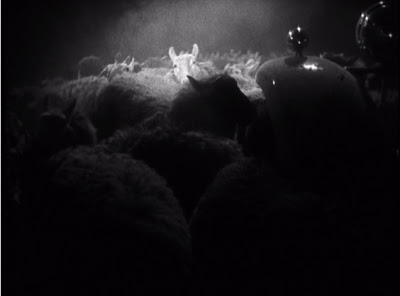
From Yasujiro Ozu's "Late Spring", 1949.


Ozu's images are very concise, avoiding the sort of techniques that would muddle the image—a dissolve, a fade, a moving camera—which is why this quiet, perfect film posed a bit of a challenge to my fetishistic urge to extract the type of near-abstract frames I've pasted all over this blog.  Here is what I found: a spare image of a train as it emerges from a tunnel.

Thursday, July 24, 2008

Hitchcock's Cynicism.


From Alfred Hitchcock's "The 39 Steps", 1935.


A businessman holds up an artifact; there is demand for brassieres and profit must be made so we shall sell brassieres.  At the same time, under the guise of commerce, he and his companion will winkingly indulge in a little titillation.  The man's wry expression typifies Hitchcock's attitude toward sex in his films.  He knows that the salivating hordes want innuendo, that a glimpse of stocking will increase the box office gross, so he will provide it but at an arm's length.  He would never be so base as to actually be aroused by it (wink).  The viewer is doubly manipulated: Hitchcock satisfies our appetite for sex while simultaneously flattering us by letting us in on the joke.

Saturday, July 19, 2008

Marilyn Connects


From Fritz Lang's "Clash By Night", 1952.


"Costumes Are Witchery and Brine"


This is not a film, more an interactive web installation, but I'd like to draw your attention to it anyway.

Jason Nelson's Evil Hypnotizing Robots.

Friday, July 18, 2008

The Pianist


From William Klein's "Mr. Freedom", 1969.


Serge Gainsbourg does his best Adrien Brody.

Thursday, July 17, 2008

Inner "Outer Space"


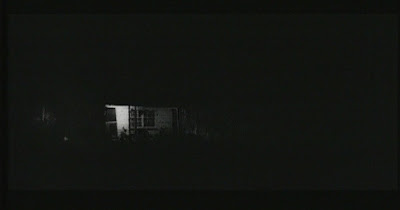
Eleven consecutive frames from the forty-third second of Peter Tscherkassky's "Outer Space", 1999.  

This monumental ten-minute film begins with the coruscating image of a house at night, an effect created using a contact printer; Tscherkassky illuminates different portions of the same "found" footage image in each frame.  The resulting stroboscopic montage is beautiful and ominous, disjointed and unsettling.

An archetypal horror image:  the exterior of the victim's house from the perspective of an unknown, presumably malicious force lurking in the darkness.  The house is brightly lit—all the better to be seen from the shadows.  The interior of the house is also dark, its inhabitants unaware and vulnerable.  The refracted image of the facade hints at the ensuing sublimation of the female resident.

These frames pass before the eye in just under half a second.