Thursday, June 25, 2009

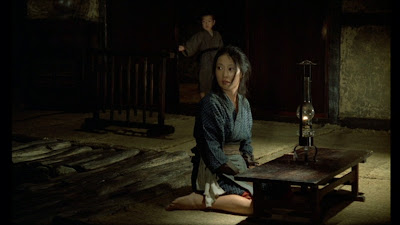
Empire Of Passion


Nagisa Oshima, 1978


A married woman has an affair with a younger man, the man grows jealous and convinces her to murder her husband, the husband haunts them and things end poorly.  The tired story is not treated particularly originally here but the sets always look great and the colors are vivid and interesting.  Next time I'll watch Taboo instead.


Friday, June 19, 2009

Three Views of a Railing


Nagisa Oshima's "Empire of Passion", 1978.


All the same room, different color schemes.

Monday, June 15, 2009

Boris Karloff


"The Mummy", Karl Freund, 1932.


As far as I can tell, the only reason to see this film.


Tuesday, June 9, 2009

Tuesday, February 10, 2009

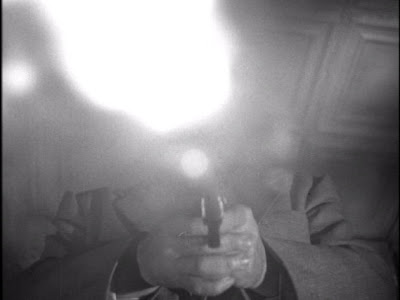
Killers #6


From Abraham Polonsky's "Force of Evil", 1949.


Sunday, January 11, 2009

Another Neat Dissolve


From Max Ophuls' "The Earrings of Madame de…", 1953


Like Preminger in "River of No Return" , Ophuls uses fire to connect two shots during a dissolve, though without the feeble metaphor.


The sentry is cold.


As the image dissolves we begin to see a fire.


The sentry turns and hunches over as though to warm himself over the General's fire.


Friday, January 9, 2009

Seamless Transition in "The Earrings of Madame de…"


Max Ophuls, 1953

After a long tracking shot of Louise (Danielle Darrieux) and Fabrizio (Vittorio De Sica) dancing at a ball, Ophuls fades to a shot of this painting and more dancing on a later night.  He employs a clever technique to maintain kinesis.


Here, the painting.


Darrieux steps in from the right of the camera, De Sica from the left.


They meet in the center of the frame .


Here they continue twirling as though they had been embracing before the shot began.


The camera resumes tracking along with them.


Had Ophuls faded from a shot of the dancing couple to another shot of dancing the image would have been cluttered.  A tracking shot where the camera met up with the couple to its left or right would have lost some kinetic tension; dancing into a motionless frame from the side would have had the same effect.  Here it is as if the camera moves backward between their heads—they seem to materialize in the center of the frame already in progress.